

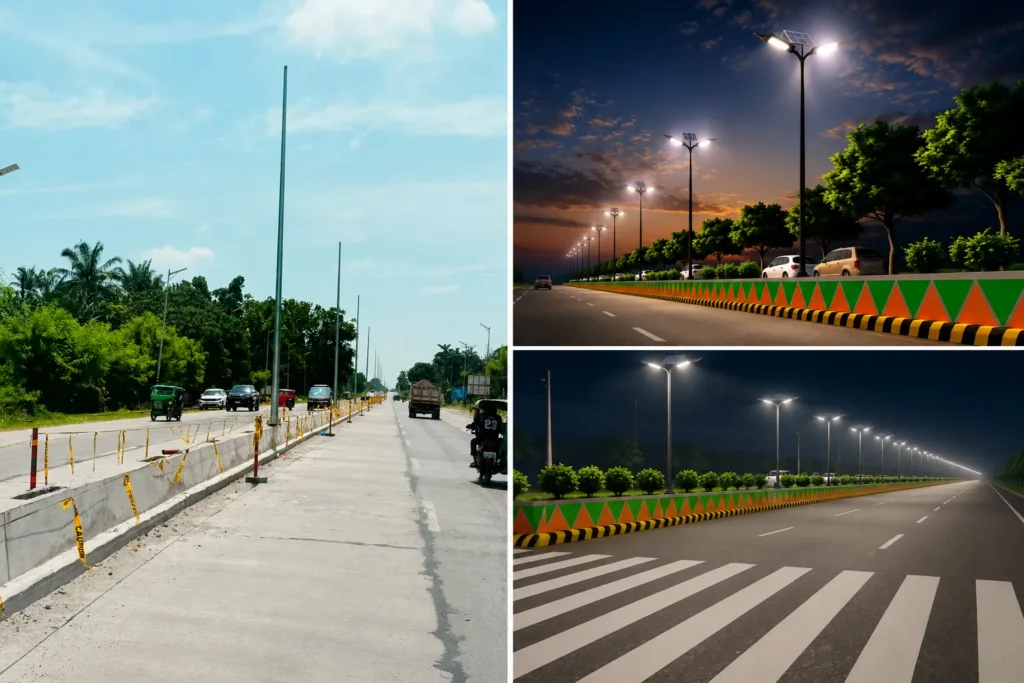
A new solar-powered infrastructure initiative is currently being implemented along the President Quirino–Tacurong City–Isulan route in Sultan Kudarat’s 1st District. The project, credited to Cong. Ruth Mangudadatu Sakaluran, aims to improve road visibility and safety through the installation of solar-powered lighting along center islands. This sustainable solution reflects ongoing efforts to enhance public infrastructure, mobility, and transportation conditions in the province, delivering “mas maliwanag na daan, mas ligtas na paglalakbay” (brighter roads, safer travel).
Key Takeaways
- Solar-powered lighting is being installed along center islands on the President Quirino–Tacurong City–Isulan route in Sultan Kudarat’s 1st District
- The initiative is credited to Cong. Ruth Mangudadatu Sakaluran as part of her infrastructure development agenda
- Solar technology provides a sustainable, cost-effective solution that reduces dependence on traditional electricity sources
- The project aims to enhance road safety, visibility, and convenience for all road users
- Similar solar lighting projects have been successfully implemented across the Philippines, demonstrating the effectiveness of this approach
Table of Contents
- Sultan Kudarat Solar Lights Project: A Brighter, Safer Road Network
- 1.1 Project Overview and Scope
- 1.2 The Route: President Quirino to Isulan
- Solar Technology: A Sustainable Solution for Roadway Lighting
- 2.1 How Solar Street Lights Work
- 2.2 Environmental and Economic Benefits
- Congresswoman Ruth Mangudadatu Sakaluran’s Infrastructure Legacy
- 3.1 A Track Record of Public Service
- 3.2 Complementary Infrastructure Initiatives
- The Importance of Road Lighting for Safety and Mobility
- 4.1 Reducing Nighttime Accidents
- 4.2 Supporting Economic Activity
- Similar Solar Lighting Projects Across the Philippines
- 5.1 DPWH Solar Streetlight Projects
- 5.2 Local Government Initiatives
- Conclusion
- Frequently Asked Questions
- Disclaimer
Sultan Kudarat Solar Lights Project: A Brighter, Safer Road Network
Project Overview and Scope
A major infrastructure initiative is currently transforming the President Quirino–Tacurong City–Isulan route in Sultan Kudarat’s 1st District. The project focuses on installing solar-powered lighting along center islands of the roadway, making the route significantly brighter and safer for motorists and commuters, particularly during nighttime travel.
This solar lighting initiative represents a practical response to the growing need for improved road safety and visibility along this critical transportation corridor. By harnessing solar technology, the project delivers sustainable and cost-effective illumination while reducing dependence on traditional electricity sources and lowering long-term operational costs.
The undertaking is credited to Cong. Ruth Mangudadatu Sakaluran, who has consistently championed infrastructure development projects that directly benefit the residents of Sultan Kudarat’s 1st District. The project forms part of broader efforts to enhance road safety, public infrastructure, mobility, and transportation conditions in the area.
The Route: President Quirino to Isulan
The initiative covers a strategic route connecting three key municipalities in Sultan Kudarat’s 1st District:
- President Quirino – a municipality in the northern part of Sultan Kudarat
- Tacurong City – a component city and the commercial hub of the province
- Isulan – the provincial capital of Sultan Kudarat
This corridor serves as a vital artery for the province, facilitating the movement of goods, services, and people between these communities. Improved lighting along this route enhances safety for all road users, including motorists, commuters, and pedestrians.
The route is part of the broader transportation network that connects Sultan Kudarat to neighboring provinces in the SOCCSKSARGEN region (Region XII). Enhanced road infrastructure along this corridor supports economic activity and improves the quality of life for residents.
Solar Technology: A Sustainable Solution for Roadway Lighting
How Solar Street Lights Work
Solar street lights operate using photovoltaic (PV) panels that convert sunlight into electricity during the day. This energy is stored in batteries and used to power LED lights during nighttime hours. The system operates automatically, turning on at dusk and off at dawn, providing reliable illumination without connection to the traditional power grid.
Key components of solar street lights include:
- Solar panels – capture sunlight and convert it to electricity
- Batteries – store energy for nighttime use
- LED lights – provide efficient, long-lasting illumination
- Charge controllers – regulate the flow of electricity to prevent overcharging
- Poles and fixtures – support the lighting system
The Sultan Kudarat solar lighting initiative utilizes this technology to provide sustainable, cost-effective roadway illumination along the President Quirino–Tacurong City–Isulan route.
Environmental and Economic Benefits
Solar-powered street lights offer significant advantages over traditional lighting systems:
Environmental Benefits:
- Reduced carbon footprint – solar energy is renewable and produces no greenhouse gas emissions
- No reliance on fossil fuels – decreases dependence on non-renewable energy sources
- Lower environmental impact – minimal disruption to surrounding ecosystems during installation
Economic Benefits:
- Reduced electricity costs – no monthly utility bills for lighting
- Lower maintenance costs – LED lights have longer lifespans than traditional bulbs
- Energy independence – not affected by power outages or grid failures
The Department of Public Works and Highways (DPWH) has been a strong advocate for solar lighting in infrastructure projects. In South Cotabato, the DPWH completed a ₱107.11-million project installing 215 double arm solar LED roadway lights along a 6.7-lane kilometer section of the Marbel-Makar Road. These projects demonstrate the effectiveness and growing adoption of solar technology in Philippine road infrastructure.
Congresswoman Ruth Mangudadatu Sakaluran’s Infrastructure Legacy
A Track Record of Public Service
Cong. Ruth Mangudadatu Sakaluran represents Sultan Kudarat’s 1st District in the House of Representatives. She has served in various public roles, including as mayor of Lutayan, Sultan Kudarat. Her legislative agenda has consistently prioritized infrastructure development, education, and public service.
Representative Sakaluran has been a driving force behind numerous infrastructure initiatives in the district. She filed House Bill (HB) 389, which seeks to convert the Municipality of Isulan into a component city, aiming to accelerate local economic growth and enable the municipal government to access greater resources to improve public services.
Her commitment to infrastructure development is reflected in projects such as the new classroom building for President Quirino National High School, completed as part of her 2024 priority infrastructure initiatives. The Sultan Kudarat solar lighting project is among her latest initiatives aimed at improving public safety and mobility in the district.
Complementary Infrastructure Initiatives
This solar lighting project is part of a broader portfolio of infrastructure initiatives in Sultan Kudarat’s 1st District. These include:
- Road improvements – including the paving of the Sampao-Bonita National Highway in Isulan
- School infrastructure – such as the new classroom building for President Quirino National High School
- Bridge and flood control projects – enhancing connectivity and disaster resilience
- Solar lighting projects – improving road safety and visibility across the district
The provincial government has also been actively pursuing infrastructure development. Governor Datu Pax Ali Mangudadatu has led groundbreaking ceremonies for projects such as the Lambayong Integrated Terminal and has supported the SKSU ACCESS Campus Pedestrian Overpass, which was implemented through collaboration between the DPWH and the provincial government.
The Importance of Road Lighting for Safety and Mobility
Reducing Nighttime Accidents
Proper roadway lighting is a critical factor in road safety. Studies have consistently shown that well-lit roads reduce the risk of accidents, particularly during nighttime hours when visibility is limited. This solar lighting project directly addresses this safety concern by providing consistent, reliable illumination along a major transportation corridor.
The Philippine National Police (PNP) and the Department of the Interior and Local Government (DILG) have both emphasized the importance of road safety measures in reducing traffic accidents and improving public safety. Solar lighting projects have been recognized as effective tools for enhancing road safety, particularly in areas with limited access to traditional electricity.
In the Municipality of Tago, for example, a similar project involved installing solar street lights along a diversion road at 50-meter intervals to prevent vehicular accidents and provide safe spaces for evening activities.
Supporting Economic Activity
Improved road infrastructure supports economic development by facilitating the movement of goods, services, and people. Well-lit roads enable businesses to operate more efficiently, reduce transportation costs, and improve access to markets.
The President Quirino–Tacurong City–Isulan route serves as a vital economic corridor for Sultan Kudarat. Enhanced lighting along this route supports:
- Agricultural trade – enabling farmers to transport produce more safely and efficiently
- Commerce – facilitating the movement of goods and services between communities
- Tourism – improving accessibility for visitors to the province
- Daily commuting – providing safer travel for workers and students
The Philippine Statistics Authority (PSA) has documented the economic importance of infrastructure development in driving regional growth. Improved road infrastructure, including solar lighting, contributes to poverty reduction and improved quality of life for residents.
Similar Solar Lighting Projects Across the Philippines
DPWH Solar Streetlight Projects
The Department of Public Works and Highways (DPWH) has been at the forefront of implementing solar streetlight projects across the country. These initiatives demonstrate the effectiveness and growing adoption of solar technology in Philippine road infrastructure.
Koronadal Road Improvement Project (South Cotabato): The DPWH constructed solar-powered lights and center islands along the Marbel-Makar Road, costing a total of ₱107.11 million. The project installed 215 double arm solar LED roadway lights along a 6.7-lane kilometer section to enhance both road safety and security.
Romblon Solar Streetlight Project: The installation of solar-powered streetlights along national roads and newly constructed road sections in Romblon has helped improve road safety and mobility for motorists and commuters.
Riverbank Protection Project (Sultan Kudarat): A ₱100-million riverbank protection project in Bagumbayan, Sultan Kudarat, includes the installation of solar LED roadway lights to enhance visibility and promote public safety.
These projects demonstrate that solar lighting is a proven, effective solution for improving road safety and mobility across the Philippines.
Local Government Initiatives
Local government units across the country have also embraced solar lighting as a cost-effective solution for improving public safety and reducing energy costs.
Tacurong City Streetlight Project: Tacurong City has implemented a ₱16 million project to install solar-powered streetlights along four major highways and all main streets in the downtown and barangay areas. The city government will soon procure 328 units of 60-watt solar streetlights to be installed along 24 major streets.
Tago Diversion Road Project: In the Municipality of Tago, a project involves constructing a center island with solar street lights at 50-meter intervals to illuminate the diversion road, prevent vehicular accidents, and serve as fitness areas during nighttime.
These local initiatives reflect the growing recognition of solar lighting as a sustainable, cost-effective solution for improving road safety and public infrastructure.
Conclusion
The solar lighting project along the President Quirino–Tacurong City–Isulan route represents a significant step forward in improving road safety, visibility, and mobility in Sultan Kudarat’s 1st District. The initiative, credited to Cong. Ruth Mangudadatu Sakaluran, demonstrates a commitment to infrastructure development and public service that directly benefits motorists, commuters, and residents.
By utilizing solar technology, the project provides a sustainable, cost-effective solution for roadway illumination, reducing dependence on traditional electricity sources and lowering long-term operational costs. This initiative is part of a broader trend across the Philippines, where solar lighting is increasingly being adopted as a practical solution for improving road safety and public infrastructure.
“Mas maliwanag na daan, mas ligtas na paglalakbay” (brighter roads, safer travel) – this message encapsulates the vision behind the project and the tangible benefits it will bring to the people of Sultan Kudarat.
For more updates on infrastructure projects in Sultan Kudarat, follow official announcements from the Provincial Government of Sultan Kudarat and the Department of Public Works and Highways (DPWH) .
Frequently Asked Questions
1. What is the Sultan Kudarat solar lights project?
This infrastructure initiative involves installing solar-powered lighting along center islands on the President Quirino–Tacurong City–Isulan route in Sultan Kudarat’s 1st District. The project aims to improve road visibility and safety for motorists and commuters, particularly during nighttime travel.
2. Who is leading this infrastructure initiative?
The project is credited to Cong. Ruth Mangudadatu Sakaluran, who represents Sultan Kudarat’s 1st District in the House of Representatives and has prioritized infrastructure development in her legislative agenda.
3. What route does the project cover?
The project spans the President Quirino–Tacurong City–Isulan corridor, a major transportation route connecting three key municipalities in Sultan Kudarat’s 1st District.
4. What are the main benefits of this project?
Motorists and commuters benefit from improved visibility, enhanced road safety, and reduced accident risks during nighttime travel. The project also supports economic activity by facilitating safer movement of goods and people along this vital corridor.
5. How does solar lighting technology work?
Solar street lights use photovoltaic panels to convert sunlight into electricity, which is stored in batteries and used to power LED lights at night. The system operates automatically, turning on at dusk and off at dawn without connection to the traditional power grid.
6. What are the environmental benefits of solar street lights?
Solar lighting reduces carbon emissions, eliminates reliance on fossil fuels, and has minimal environmental impact during installation. It provides renewable, sustainable illumination without contributing to greenhouse gas emissions.
7. Are there similar projects elsewhere in the Philippines?
Yes. The DPWH has implemented solar streetlight projects across the country, including the ₱107.11-million Koronadal Road Improvement Project in South Cotabato and various initiatives in Romblon, Sultan Kudarat, and other provinces.
8. Is the project currently ongoing?
Yes, based on the public announcement, the solar lighting initiative is currently being implemented along the specified route.
9. How can I stay updated on this and similar projects?
Follow official announcements from the Provincial Government of Sultan Kudarat , the Department of Public Works and Highways (DPWH) , and SultanKudarat.com for ongoing coverage of infrastructure developments in the province.
10. What other infrastructure projects has Cong. Sakaluran initiated?
Representative Sakaluran has championed numerous initiatives, including the new classroom building for President Quirino National High School and House Bill 389, which seeks to convert Isulan into a component city. She has also supported various road improvement and flood control projects in the district.
Disclaimer
This article is based on the public announcement regarding the Center Islands with Solar Lights Project in Sultan Kudarat’s 1st District. The information presented reflects the announcement as of the date of publication. Specific details regarding the number of lights, exact locations, completion dates, budget amounts, and technical specifications have not been disclosed and are therefore not included in this article. SultanKudarat.com strives to provide accurate and timely information but does not guarantee the completeness or absolute accuracy of the details contained herein. Readers are encouraged to verify official announcements from the Provincial Government of Sultan Kudarat and other authorized government agencies for the most current updates.