
Columbio, Sultan Kudarat: History, Attractions and Municipal Guide
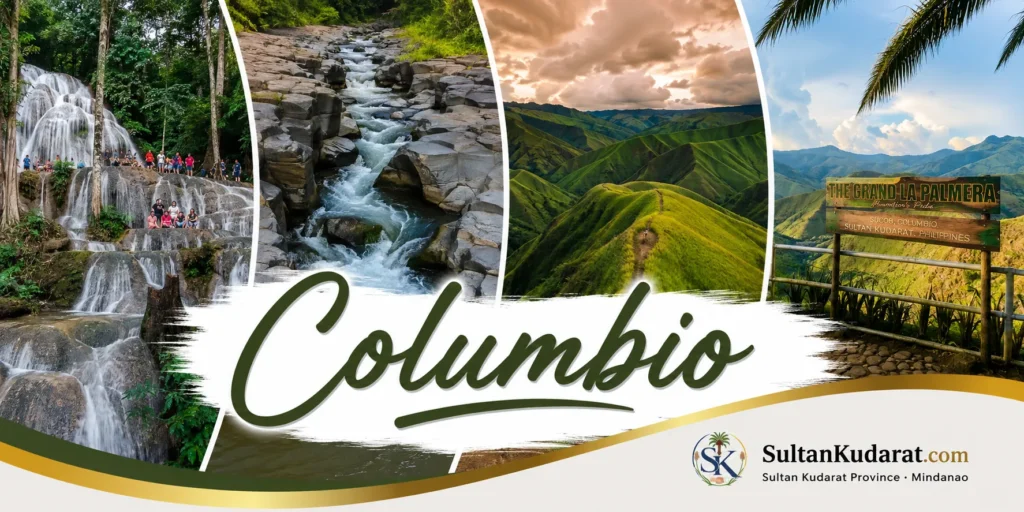
Columbio is a first-class, landlocked municipality in the Province of Sultan Kudarat, within the SOCCSKSARGEN Region (Region XII) of the Philippines. Located in the eastern portion of the province, Columbio has an extensive landscape of mountains, valleys, forests, rivers, waterfalls, agricultural areas, and rural communities.
The municipality is known for La Palmera Mountain Ridge, Pangadilan Falls, Fekung Bula Falls, Fetam Klego Underground River, and its Blaan cultural heritage. Agriculture, local trade, government services, and developing tourism activities contribute to its economy and community life.
Quick Facts About Columbio
| Information | Details |
|---|---|
| Official name | Municipality of Columbio |
| Province | Sultan Kudarat |
| Region | SOCCSKSARGEN (Region XII) |
| Municipality type | Landlocked municipality |
| Income classification | 1st-class municipality |
| Date created | August 6, 1961 |
| Legal basis | Executive Order No. 439, series of 1961 |
| Originally part of | Municipality of Buluan, former Province of Cotabato |
| Part of Sultan Kudarat since | November 22, 1973 |
| Population | 33,337 residents (2024 Census) |
| Barangays | 16 |
| Land area | Approximately 926.15 square kilometers |
| ZIP code | 9801 |
| PSGC | 1206502000 |
| Time zone | Philippine Standard Time (UTC+8) |
| Commonly spoken languages | Cebuano, Hiligaynon, Maguindanaon, Blaan, Ilocano, Filipino, and English |
Why Visit Columbio?
Columbio offers mountain scenery, waterfalls, caves, an underground river, agricultural landscapes, and opportunities to learn about local and Indigenous culture. Its natural attractions appeal to visitors interested in hiking, photography, responsible outdoor recreation, and destinations beyond heavily urbanized areas.
Visitors come to Columbio for its:
- La Palmera Mountain Ridge
- Pangadilan Falls
- Fekung Bula Falls
- Fetam Klego Underground River
- Mountain and agricultural landscapes
- Blaan cultural heritage
- Kastifun Festival
- Nature photography and outdoor recreation
History of Columbio
The area now known as Columbio has long been inhabited by Indigenous communities, particularly the Blaan, together with Maguindanaon and other communities. Their histories, customary practices, livelihoods, and relationships with the land remain an important part of the municipality’s cultural identity.
The name “Columbio” has been associated with the Blaan expression “Colon-biao.” Local historical accounts connect the name with the presence of cogon grass and lumbang trees in the area. Because explanations of place names may vary, this origin should be presented as a local account rather than an undisputed linguistic fact.
Columbio was created through Executive Order No. 439, signed by President Carlos P. Garcia on August 6, 1961. The order separated specified barrios and sitios from the Municipality of Buluan in the former Province of Cotabato and organized them into the independent Municipality of Columbio. Barrio Columbio was designated as the seat of government.
The executive order provided that the municipality would begin to exist upon the appointment and qualification of its mayor, vice mayor, and a majority of its councilors, together with the required certification of financial capability.
On November 22, 1973, Presidential Decree No. 341 divided the former Province of Cotabato and included Columbio in the newly created Province of Sultan Kudarat.
Geography and Location
Columbio is a landlocked municipality in the eastern portion of Sultan Kudarat. Its extensive territory includes mountains, valleys, agricultural lands, rivers, forests, and remote rural communities.
The municipality’s original legal boundaries extended toward the former Cotabato–Davao boundary and included Mount Alip as a major geographic reference. Present-day Columbio lies near the boundaries of Sultan Kudarat, South Cotabato, Davao del Sur, and Cotabato Province.
The municipality’s size and mountainous terrain mean that travel conditions vary significantly between the Poblacion and distant barangays. Access to some attractions and upland communities may require local coordination, suitable vehicles, or travel on unpaved roads.
Columbio’s terrain supports agriculture, watersheds, forest ecosystems, rural settlements, and nature-based tourism.
Population and Barangays
Columbio had a population of 33,337 as of July 1, 2024, according to the Philippine Statistics Authority. It is politically divided into 16 barangays.
The barangays are Bantangan, Datablao, Eday, Elbebe, Lasak, Libertad, Lomoyon, Makat, Maligaya, Mayo, Natividad, Poblacion, Polomolok, Sinapulan, Sucob, and Telafas.
Poblacion was the most populous barangay in the 2024 Census, with 7,758 residents. It was followed by Datablao and Telafas.
Climate
Columbio has a generally warm tropical climate, although temperatures and rainfall vary according to elevation and location. Upland areas may experience cooler conditions than lower agricultural valleys.
Visitors should check current weather and road conditions before traveling to mountain areas, caves, waterfalls, or remote barangays. Heavy rain may make roads and trails difficult or unsafe.
Economy
Agriculture plays a central role in Columbio’s economy, supported by agricultural trade, retail activity, transportation, construction, government services, and small enterprises.
Major economic sectors include:
- Agriculture
- Agribusiness
- Eco-tourism
- Retail trade
- Transportation
- Government services
- Construction
- Small businesses
- Education
Local development opportunities include agricultural production, product processing, community enterprises, and responsible tourism. Specific programs should be verified through current municipal plans and announcements.
Agriculture
Columbio’s agricultural areas support staple crops, fruit production, commercial crops, poultry, and livestock.
Major agricultural products include:
- Rice
- Corn
- Banana
- Coconut
- Rubber
- Coffee
- Cacao
- Durian
- Vegetables
- Poultry
- Livestock
Coffee, cacao, fruit, and other high-value crops may provide diversification opportunities for farmers, although current production levels should be confirmed through municipal or Philippine Statistics Authority agricultural data.
Education
Columbio provides educational opportunities through public and private institutions serving learners from elementary to secondary education.
Educational facilities include:
- Public elementary schools
- National high schools
- Private schools
- Technical-vocational programs
- Community learning centers
Students seeking tertiary programs unavailable locally may enroll in institutions elsewhere in Sultan Kudarat, South Cotabato, Cotabato Province, or neighboring areas. Travel choices depend on program availability, distance, and transportation conditions.
Healthcare
Residents have access to essential healthcare through government facilities and community health services.
Healthcare facilities include:
- Rural Health Unit
- Barangay Health Stations
- Medical clinics
- Dental clinics
- Maternal and child healthcare services
- Immunization programs
- Pharmacies
Patients requiring services unavailable locally may be referred to larger healthcare facilities elsewhere in Sultan Kudarat or neighboring provinces. Travel time and accessibility depend on the resident’s barangay, road conditions, and available transportation.
Business and Commerce
Columbio’s commercial district supports both residents and surrounding agricultural communities.
Business establishments include:
- Public market
- Agricultural supply stores
- Grocery stores
- Hardware shops
- Pharmacies
- Restaurants
- Cooperatives
- Rice and corn traders
- Financial service providers
Commercial activity primarily serves local households, farmers, agricultural traders, government workers, and small enterprises.
Tourist Attractions
Columbio is home to mountain ridges, waterfalls, caves, an underground river, agricultural landscapes, and Indigenous communities. Several attractions are located outside the Poblacion and may require local guides, appropriate transportation, and advance coordination.
La Palmera Mountain Ridge
La Palmera Mountain Ridge, located in Barangay Sucob, is one of Columbio’s best-known destinations. It offers sweeping views of green ridges, valleys, farms, and surrounding mountain scenery.
The destination has been promoted by the Department of Tourism as one of Sultan Kudarat’s notable natural attractions. Tourism infrastructure development for La Palmera has also been identified by the Tourism Infrastructure and Enterprise Zone Authority.
Visitors should verify current operating hours, entrance fees, road conditions, available activities, and access rules before traveling.
Pangadilan Falls
Pangadilan Falls, sometimes described in tourism materials as Pangadilan Rock Formation Falls, is one of Columbio’s recognized natural attractions. Its flowing water and surrounding rock formations create opportunities for sightseeing and nature photography.
Visitors should check trail conditions and water levels and arrange for a knowledgeable local guide. Swimming should only be attempted when local authorities or site managers confirm that conditions are safe.
Fekung Bula Falls
Fekung Bula Falls is another natural attraction associated with Columbio. It highlights the municipality’s forested terrain, freshwater systems, and potential for responsible nature tourism.
Accessibility and visitor facilities may be limited. Travelers should obtain current directions and permission from the local tourism office or host community.
Fetam Klego Underground River
Fetam Klego Underground River is a cave-and-river attraction identified in regional tourism promotion. Visiting an underground river requires greater preparation than ordinary sightseeing.
Visitors should enter only with authorization, a trained local guide, proper lighting, helmets, suitable footwear, and information about current weather and water conditions. Entry during or after heavy rain can be dangerous.
Agricultural and Mountain Landscapes
Columbio’s farms, valleys, mountain roads, and rural communities provide scenic views and opportunities to learn about local agriculture. Farms and community lands should not be treated as automatically open tourist sites. Visitors must obtain permission before entering private property, plantations, or Indigenous community areas.
Responsible Visitor Reminder
Travelers should coordinate with Columbio’s tourism or disaster-management personnel before visiting remote destinations. Respect cultural protocols, Indigenous Peoples’ rights, private property, environmental rules, and local safety instructions. Avoid leaving waste, damaging plants or rock formations, or entering caves and waterways without qualified assistance.
The Department of Tourism and PIA identify La Palmera, Pangadilan Falls, Fekung Bula, and Fetam Klego as Columbio attractions. PIA tourism report
Festivals and Cultural Celebrations
Columbio’s celebrations reflect its municipal history, Indigenous heritage, agricultural communities, and cultural diversity.
Kastifun Festival
Festival dates, venues, and programs may change each year. Visitors should consult announcements from the Municipal Government of Columbio before making travel arrangements.
Kastifun Festival is Columbio’s municipal festival and is celebrated in connection with the municipality’s founding anniversary in August. The celebration brings communities together through cultural presentations, civic activities, entertainment, sports, and other public programs.
The festival provides an opportunity to recognize Columbio’s different cultural communities, including its Blaan and Maguindanaon residents and migrant communities from other parts of the Philippines.
Indigenous Cultural Heritage
Blaan communities form an important part of Columbio’s history and living cultural heritage. Indigenous knowledge, customary practices, farming traditions, language, arts, and relationships with ancestral lands contribute to the municipality’s identity.
Cultural communities should not be treated as tourist displays. Visitors, researchers, photographers, and tour organizers should obtain informed permission before entering community areas, documenting ceremonies, photographing residents, or sharing cultural knowledge. Ancestral-domain rules and guidance from Indigenous elders and the National Commission on Indigenous Peoples should be respected.
Transportation
Columbio is connected to neighboring municipalities through national and provincial roads.
Transportation options include:
- Jeepneys
- Vans for hire
- Tricycles
- Provincial buses (connecting routes)
- Private vehicles
Columbio is reached primarily by road. Routes may connect through other parts of Sultan Kudarat, South Cotabato, Cotabato Province, or Davao del Sur, depending on the traveler’s starting point.
Public-transport availability, schedules, fares, and departure points may change. Transportation to remote barangays and natural attractions can be limited. Visitors should ask the municipal tourism office or their accommodation provider for current route information before traveling.
Government Services
The Municipal Government of Columbio delivers essential public services through various local offices.
Key government offices include:
- Municipal Hall
- Municipal Health Office
- Municipal Agriculture Office
- Civil Registry Office
- Business Permit and Licensing Office
- Municipal Social Welfare and Development Office
- Philippine National Police
- Bureau of Fire Protection
- Disaster Risk Reduction and Management Office
These institutions support agricultural development, environmental protection, public safety, and community welfare.
Investment Opportunities
Columbio may offer investment opportunities connected with agriculture, product processing, local services, and carefully managed tourism.
Promising investment sectors include:
- Eco-tourism
- Coffee processing
- Cacao production
- Fruit processing
- Agribusiness
- Hospitality
- Farm tourism
- Warehousing
- Food processing
Prospective investors should verify land classification, ancestral-domain rights, environmental regulations, infrastructure availability, water use, market conditions, and permit requirements before developing a project.
Frequently Asked Questions
Where is Columbio located?
Columbio is located in the province of Sultan Kudarat in the SOCCSKSARGEN Region (Region XII), Philippines.
What is Columbio known for?
Columbio is known for La Palmera Mountain Ridge, Pangadilan Falls, Fekung Bula Falls, Fetam Klego Underground River, its agricultural landscapes, and Blaan cultural heritage.
What are the major crops grown in Columbio?
Farmers produce rice, corn, banana, coconut, rubber, coffee, cacao, durian, vegetables, and other high-value crops.
What languages are spoken in Columbio?
Residents commonly speak Cebuano, Hiligaynon, Maguindanaon, Blaan, Filipino, and English.
Is Columbio good for eco-tourism?
Yes. Columbio is one of the leading eco-tourism destinations in Sultan Kudarat because of its waterfalls, rivers, forests, mountain landscapes, and biodiversity.
Is Columbio good for investment?
Yes. The municipality offers opportunities in eco-tourism, agribusiness, coffee and cacao production, hospitality, renewable energy, and sustainable agriculture.
When was Columbio created?
Columbio was created through Executive Order No. 439, signed on August 6, 1961. The order separated its original territory from the Municipality of Buluan in the former Province of Cotabato.
What is Columbio’s population?
Columbio had 33,337 residents as of July 1, 2024, according to the Philippine Statistics Authority.
How many barangays does Columbio have?
Columbio is politically divided into 16 barangays.
What is Columbio known for?
Columbio is known for La Palmera Mountain Ridge, Pangadilan Falls, Fekung Bula Falls, Fetam Klego Underground River, mountain and agricultural scenery, and Blaan cultural heritage.
Is Asik-Asik Falls in Columbio?
No. Asik-Asik Falls is located in Alamada, Cotabato Province. It should not be confused with the waterfalls and mountain attractions found in Columbio.
What is Columbio’s municipal festival?
Columbio celebrates Kastifun Festival in connection with its founding anniversary in August.
Is a local guide recommended?
Yes. A knowledgeable local guide is strongly recommended when visiting caves, underground rivers, waterfalls, mountain areas, and remote communities. Visitors should also check weather, road, and access conditions.
Discover Columbio
Columbio brings together mountain scenery, waterfalls, an underground river, agricultural communities, Indigenous heritage, and developing tourism destinations. La Palmera Mountain Ridge, Pangadilan Falls, Fekung Bula Falls, Fetam Klego Underground River, and Kastifun Festival provide different ways to experience the municipality.
Visitors should plan carefully, coordinate with local tourism personnel, respect Indigenous and private lands, and follow safety and environmental rules when exploring remote natural attractions.